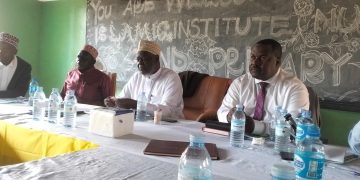

KASESE — Conservationists have asked government to allocate more resources to help scale up the much sought-after restoration process of River Nyamwamba as they work to cover the whole catchment area.
The Rwenzori Mountains are one of the largest single and most significant water catchment areas in Uganda, and the African region at large. As a catchment area, over 5 million people in the Rwenzori region depend on this mountain source for household water usage.
Related posts


The government of Uganda, through Ministry of Water and Environment (MWE) and World Wide Fund – Uganda (WWF) is rolling out an emergency response plan to restore River Nyamwamba catchment area in Kasese, but conservationists say most of the work is on an emergency basis with very little impact.

Kasese district experiences devastating floods every year— with River Nyamwamba always bursting its banks, leaving a trail of massive destruction.
Government secured funding from the World Bank to implement integrated water management and development projects in different water management zones of Uganda.
One of the projects is supporting the implementation of priority Catchment Management Measures in the upper and the Mid streams of River Nyamwamba.
During an inspection tour that also included evaluating an emergency response program for river bank management and restoration for River Nyamwamba which only covers five percent of the catchment area, Mr. David Duli, the country director WWF Uganda country office called for an immediate implementation of a holistic integrated planning for all rivers originating from the Rwenzori mountains if flooding and its effects are to be dealt with permanently.
He reasoned there is a need to roll out mass campaigns to cover all the bare hills and encourage communities to voluntarily conserve the environment.
Duli whose organization was contracted to implement the project also noted that government’s involvement in the environment issues of Kasese is a welcome development in the lives of the people of Rwenzururu region.

During a guided tour, Mr. Duli also briefed the delegation about the catastrophic situation at River Nyamwamba—blaming the frequent floods partly to an inferno that in 2012 gutted hundreds of vegetation on Mt Rwenzori, leaving several areas bare.
He said the fire burnt thick mattress-like surfaces which had formed over centuries, regulating the water speed on the steep mountain slopes.
He said the vegetation recovery was very slow and frequently disrupted when heavy running water occurs.
“Whenever it rains heavily, the now poorly vegetated areas can no longer regulate the water that gushes down into the mountain lakes from which these rivers form, invading the communities downstream,” he said.
He added that the glaciers that used to maintain the temperature on the almost 1,000sqkm Mt Rwenzori were also melting at a worrying pace.
“About 120 years ago, the glaciers covered 15sqkm of the Mt Rwenzori. But they have now receded to less than 8sqkm. If this loss goes uncontrolled, there will be no snow on the mountain by 2030,” he warned.
Duli said the loss of the glaciers will have regrettable impacts on Uganda’s economy as Mt Rwenzori will no longer attract tourists whose major interest is to visit the only snow-capped mountain along the Equator in the whole world.
On his part, Joseph Kule Muranga, the prime minister Obusinga Bwa Rwenzururu urged government extend conservation interventions along the whole catchment area.
They said that similar interventions have failed in the past because they were only concentrated on a small part of a single river.
Ms. Evelyn Mugume, the Senior Environmental Officer for Kasese Municipality told this website that they have so far restored upto 24 kilometres out of the much sought-after 30 catchment area.
She adds that nine community groups have been trained in soil and water conservation and 12 demonstration gardens have been set up.
Bamboo was among the trees planted in the immediate parts of River Nyamwamba banks —with Mugume telling reporters that “its roots stabilize the soil and catch silt, helping keep the riverbanks from collapsing”.
“Bamboo has spreading roots which hold the soil very firmly and can allow water to still pass through while controlling the speed and strength,” she said, also describing bamboo as “a wonder plant that can alter the challenges of climate change.”
That includes “providing a sustainable, renewable source of charcoal, resistant construction materials and a sustainable, income-generating alternative to wood cutting.”
Speaking at the sidelines of the event, NEMA’s Natural Resources Manager in charge of biodiversity, Mr. Francis Ogwal, said: “The responsibility of taking care of the environment rests on the hands of all of us. Let us keep working as a team for the betterment and sustainability of our environment.”
Mr. Ogwal represented the Authority’s Executive Director Dr. Barirega Akankwasah.
On his part, Alfred Okot Okidi, the Permanent Secretary in the Ministry of Water assured conservationists the leadership of Kasese District that his ministry has contracted experts carrying out studies for the greater Rwenzori area to find permanent solutions to the disastrous flooding.
“We are hopeful that once the studies are completed it will guide us on how to go about this whole process,” he said also explained that:
“Currently we are only carrying out emergency measures to ensure that in case of flooding, the impact is not severe.”
Okidi explained that the current interventions have started yielding results attributing it to the use of the community-led approaches in the restoration campaign.

The Kasese experience
Kasese District is prone to destructive rains especially in the months of April, May, September and October every year.
These rains, normally, come with heavy floods streaming into the low lands through the gorges, valleys and the Nyamwamba valley in general.
Nyamwamba valley, also known as Kilembe valley, is home to housing estates of the Mines, workshops, schools, the hospital, trading centres and the underground mine entrances. The floods have, in the past, destroyed part of the valley sweeping almost all the bridges over the river save for a couple of them.
They have also destroyed parts of a school, residencies, the old KML fuel station, and other areas.
Recent actions
WWF has worked with the communities to undertake catchment-based participatory inclusive actions and implemented community driven activities aimed at improving soil and water conservation, riverbank restoration and livelihood improvement.
Recent research by Busitema University indicates that since 1966 when River Nyamwamba surged to unprecedented levels, the river floods three to four times a year with the most severe occurrences happening in May 2013 and May 2020.
The Nyamwamba is part of the Nyamwamba River Watershed, which covers an area of approximately 750 hectares in Western Uganda’s Kasese district.
It is a key natural resource, safeguarding water for domestic use for over 1 million people and supplying water for a variety of industrial users including hydropower and mining companies.
These water-dependent industries are key economic growth engines and major employers in the region and beyond.
The main economic activity in the area is subsistence farming, with cultivated land of two acres on average per household. Coffee is the major cash crop grown in the watershed. The cultivated land with slopes of on average 25% in the landscape has been heavily eroded and yields are limited due to fragile soils and poor farming techniques that exacerbate soil degradation.
Both NEMA and WWF support the restoration project focusing on protecting important water catchments for socio-economic development as well as biodiversity conservation.
WWF is separately implementing other measures a Payments for Watershed Services (PWS) approach-an innovative sustainable financing mechanism aimed at encouraging private and public sector agencies to actively engage in supporting and financing ecosystem conservation.

The project aims to restore degraded hotspots, mitigate siltation and associated flooding risk and improve water quality and flow variability.
By mobilizing land owners for Sustainable Land Management (SLM) interventions to increase farm productivity, the project wants to improve community livelihoods upstream while at the same time ensuring sustainable water supply to the many users downstream and beyond.
Thanks to these projects, alternative sources of income will be created for the local communities.
By improving livelihoods of some 900 families the project also supports the Ugandan government’s effort of increasing wealth at the household level, also related to SDG 1 ‘end poverty in all its forms everywhere’.